
Kenneth Fisher
Rocco Armonda

See the Video: HERE
Henry Marsh

See the Video: HERE
Geoffrey Ling
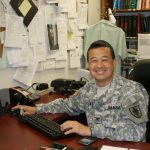
Colonel honored with humanitarian award from the Brain Mapping Foundation for work with TBI FALLS CHURCH, VA (June 11, 2012) — U.S. Army Colonel Geoffrey S. F. Ling, M.D., Ph.D., who has been at the cutting edge of brain injury research since the mid 1990s was awarded the Humanitarian Award from the Brain Mapping Foundation in a ceremony in Toronto, Canada earlier this month. Ling is a professor and the interim Chairman of the Department of Neurology at the U.S.’s only military medical school–the Uniformed Services University (USU) and also the Program Director at the Defense Advanced Research Projects Agency (DARPA). Ling was the Army’s only neuro-intensive care specialist for many years. Therefore, he has had the opportunity to remain at USU since 1995. His expertise was needed to teach and train the medical students. “Colonel Ling is a remarkable scientist and a compassionate physician who has helped train the finest doctors at USU,” said Ret. Vice Admiral Adam S. Robinson, Director of GPS Program of the Brain Mapping Foundation. “I am blown away by receiving this award,” said Ling who is regarded by many as the Army’s premier subject matter expert on traumatic brain injury (TBI). “It was totally unexpected and is a tremendous honor.” Ling led the building of the neuro-trauma laboratory at USU in the 90s where they primarily studied TBI. He has deployed multiple times to Afghanistan where he treated countless service members and civilians. He said that Operations Iraqi and Enduring Freedom made TBI a big deal due to the nature of the injuries coming from those theaters. “The wars gave the study and treatment of TBI legs,” said Ling. “But, I had already been studying it for years.” Ling who is officially assigned to a critical care billet at the USH has published more than 150 publications. He also wrote the TBI chapter in the Cecil Textbook of Medicine, which is regarded by many in the medical field as “the granddaddy” of general internal medicine texts. He also helped author the Department of Defense/Veteran’s Administration’s (DOD/VA) guidelines on TBI. Additionally, because of his background in intensive care, Ling also has the opportunity to provide direct patient care. One of his first TBI patients in Afghanistan was a little girl who had fallen off of a roof. “That’s one of the great things that I get to do.” he said. “I have the ability to actually take care of patients,” said Ling. “We’ve created a system of care for TBI that is the best in the world,” said Ling. “I’m very proud of the military system of care for TBI. The military does this better than anybody,” said Ling. Ling gave this example: “Take a kid who plays soccer. The boy gets hit in the head. He’s taken to a local hospital. He may or may not see a doctor. They may send him home without a scan. Three or four days later, the kid doesn’t feel right. He’s having headaches. Nobody knows what to do.” On the military side, Ling said, the same kid will undergo a full neurology screening, be seen at a concussion care center, and receive training on mild TBI. “Our model should be the standard,” said Ling. “We take care of TBI patients better than any hospital in the U.S.” Ling also practices at Johns Hopkins Hospital where he did his neuro-intensive care training. “Hopkins says we [the military] are the best,” said Ling. “We want everybody to adopt our system. TBI requires a system of care. The military has that system,” he said. Ling was on all four of former Chairman of the Joint Chiefs of Staff Admiral Michael Mullen’s “Gray Teams” that were established to look at the state of TBI in the military. Additionally, he was on the team of physicians who treated U.S. Representative Gabrielle Giffords who was shot in the head in 2011. “Her primary doctor, Dr. Peter Rhee, was a former Navy Captain trauma surgeon. He got his experience on the ground in Fallujah, Iraq. He was totally in control and knew exactly what to do,” said Ling who expects Gifford’s condition to continue to improve. “She got the best military care for her brain injury at the hands of a military doctor,” he said. Ling said that TBI has been around forever. But, gained prominence because of the lingering wars. “It [TBI] was a problem asking for an answer,” he said. “So, I got involved.” “The wars gave TBI traction within the DOD. That got us the resources we needed to manage this problem. The bottom line is it’s all about taking care of the wounded warfighter,” he said. “So, we were able to develop this system of care for TBI.” Since the year 2000 more than 235,000 service members worldwide have been diagnosed with TBI, which is defined as a disruption of brain function resulting from a blow or jolt to the head or penetrating head injury. More than 60 percent of service members diagnosed with TBI are U.S. Army Soldiers. Ling said that TBI is treatable and the key to treatment is to seek help immediately. Though the wars are winding down, TBI now has momentum and support from the DOD, according to Ling. “The disease won’t go away, but neither will our system of care for the wounded warfighter,” said Ling. “And that’s the positive legacy of this [war].” Ling said that the VA has become a great partner with the DOD in the treatment of TBI. Though the goal is to return as many to duty as possible, sometimes service members must be separated from the military. Because of the DOD/VA partnership, the transition from the military health care system to the VA health care system is smoother, he said. “The war fighter will continue to get really good care for as long as they need it. The DOD/VA partnership is one that the American people can be quite proud of,” said Ling. For more information on Col.
Ming Hsieh

Charlie Teo

See the Video: HERE
Bill Wood
See Video: HERE
Lee Stein-Wood
See Video: HERE
C. L. Max Nikias

Deepak Chopra
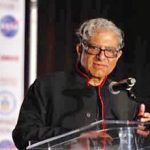
From Wikipedia Deepak Chopra (/ˈdiːpɑːk ˈtʃoʊprə/; Hindi: [diːpək tʃoːpɽa]; born October 22, 1946) is an Indian-American author and alternative medicine advocate.[4][5] A prominent figure in the New Age movement,[6] his books and videos have made him one of the best-known and wealthiest figures in alternative medicine.[7] His discussions of quantum healing have been characterised as technobabble – “incoherent babbling strewn with scientific terms”[8] which drives those who actually understand physics “crazy”[9] and as “redefining Wrong”.[10] Chopra studied medicine in India before emigrating in 1970 to the United States, where he completed a residency in internal medicine and a fellowship in endocrinology. As a licensed physician, in 1980 he became chief of staff at the New England Memorial Hospital (NEMH).[11] In 1985, he met Maharishi Mahesh Yogi and became involved in the Transcendental Meditation (TM) movement. Shortly thereafter, Chopra resigned his position at NEMH to establish the Maharishi Ayurveda Health Center.[12] In 1993, Chopra gained a following after he was interviewed about his books on The Oprah Winfrey Show.[13] He then left the TM movement to become the executive director of Sharp HealthCare‘s Center for Mind-Body Medicine. In 1996, he co-founded the Chopra Center for Wellbeing.[11][12][14] Chopra claims that a person may attain “perfect health”, a condition “that is free from disease, that never feels pain”, and “that cannot age or die”.[15][16] Seeing the human body as undergirded by a “quantum mechanical body” composed not of matter but energy and information, he believes that “human aging is fluid and changeable; it can speed up, slow down, stop for a time, and even reverse itself,” as determined by one’s state of mind.[15][17] He claims that his practices can also treat chronic disease.[18][19] The ideas Chopra promotes have regularly been criticized by medical and scientific professionals as pseudoscience.[20][21][22][23] The criticism has been described as ranging “from the dismissive to…damning”.[20] Philosopher Robert Carroll writes that Chopra, to justify his teachings, attempts to integrate Ayurveda with quantum mechanics.[24] Chopra says that what he calls “quantum healing” cures any manner of ailments, including cancer, through effects that he claims are literally based on the same principles as quantum mechanics.[19] This has led physicists to object to his use of the term “quantum” in reference to medical conditions and the human body.[19] Evolutionary biologist Richard Dawkins has said that Chopra uses “quantum jargon as plausible-sounding hocus pocus“.[25] Chopra’s treatments generally elicit nothing but a placebo response,[7] and they have drawn criticism that the unwarranted claims made for them may raise “false hope” and lure sick people away from legitimate medical treatments.[20] Biography[edit] Early life and education[edit] Chopra was born in New Delhi,[26] British India to Krishan Lal Chopra (1919–2001) and Pushpa Chopra.[27] His paternal grandfather was a sergeant in the British Indian Army. His father was a prominent cardiologist, head of the department of medicine and cardiology at New Delhi’s Moolchand Khairati Ram Hospital for over 25 years, and was also a lieutenant in the British army, serving as an army doctor at the front at Burma and acting as a medical adviser to Lord Mountbatten, viceroy of India.[28] As of 2014, Chopra’s younger brother, Sanjiv Chopra, is a professor of medicine at Harvard Medical School and on staff at Beth Israel Deaconess Medical Center.[29] Chopra completed his primary education at St. Columba’s School in New Delhi and graduated from the All India Institute of Medical Sciences in 1969.[citation needed] He spent his first months as a doctor working in rural India, including, he writes, six months in a village where the lights went out whenever it rained.[30] It was during his early career that he was drawn to study endocrinology, particularly neuroendocrinology, to find a biological basis for the influence of thoughts and emotions.[31] He married in India in 1970 before emigrating, with his wife, to the United States that same year.[13] The Indian government had banned its doctors from sitting for the exam needed to practice in the United States. Consequently, Chopra had to travel to Sri Lanka to take it. After passing, he arrived in the United States to take up a clinical internship at Muhlenberg Hospital in Plainfield, New Jersey, where doctors from overseas were being recruited to replace those serving in Vietnam.[32] Between 1971 and 1977, he completed residencies in internal medicine at the Lahey Clinic in Burlington, Massachusetts, the VA Medical Center, St Elizabeth’s Medical Center, and Beth Israel Deaconess Medical Center in Boston.[33] He earned his license to practice medicine in the state of Massachusetts in 1973, becoming board certified in internal medicine, specializing in endocrinology.[34] East Coast years[edit] Chopra taught at the medical schools of Tufts University, Boston University, and Harvard University,[35][36][37] and became Chief of Staff at the New England Memorial Hospital (NEMH) (later known as the Boston Regional Medical Center) in Stoneham, Massachusetts before establishing a private practice in Boston in endocrinology.[38] Maharishi Mahesh Yogi was an influence on Chopra in the 1980s. While visiting New Delhi in 1981, he met the Ayurvedic physician Brihaspati Dev Triguna, head of the Indian Council for Ayurvedic Medicine, whose advice prompted him to begin investigating Ayurvedic practices.[39] Chopra was “drinking black coffee by the hour and smoking at least a pack of cigarettes a day.”[40] He took up Transcendental Meditation to help him stop, and as of 2006, he continued to meditate for two hours every morning and half an hour in the evening.[41] Chopra’s involvement with TM led to a meeting in 1985 with the leader of the TM movement, Maharishi Mahesh Yogi, who asked him to establish an Ayurvedic health center.[12][42] He left his position at the NEMH. Chopra said that one of the reasons he left was his disenchantment at having to prescribe too many drugs: “[W]hen all you do is prescribe medication, you start to feel like a legalized drug pusher. That doesn’t mean that all prescriptions are useless, but it is true that 80 percent of all drugs prescribed today are of optional or marginal benefit.”[43] He became the founding president of the American Association of Ayurvedic Medicine, one of the founders of Maharishi Ayur-Veda Products International, and medical director of the Maharishi Ayur-Veda Health Center in Lancaster, Massachusetts. The center charged between $2,850 and $3,950 per week for Ayurvedic cleansing rituals such as massages, enemas, and oil baths, and TM lessons cost an additional $1,000. Celebrity patients included Elizabeth Taylor.[44] Chopra also became one of the TM movement’s spokespeople. In 1989, the Maharishi awarded him the title “Dhanvantari of Heaven and Earth” (Dhanvantari was the Hindu physician to the gods).[45] That year Chopra’s Quantum Healing: Exploring the Frontiers of Mind/Body Medicine was published, followed by Perfect Health: The Complete Mind/Body Guide (1990).[11] West Coast years[edit] In June 1993, he moved to